
A Guide to Embedded Finance: Bringing Financial Services to the Point of Need

For most of banking history, the relationship between a financial institution and its customer was built around a destination. First, that destination was the branch. Then ATMs extended access beyond banking hours, online banking moved services into the home, and mobile banking put them into our pockets. The destination changed, but the underlying behaviour remained largely the same: when customers needed a financial service, they went to their financial institution to get it.
Embedded finance changes that relationship. Instead of requiring people to leave what they are doing and enter a separate financial journey, financial services can be delivered directly into the places where the need for them occurs. A payment appears within a checkout, financing becomes available while purchasing equipment, or a business accesses credit from within the software it already uses to run its operations.
The financial service hasn't disappeared. It has moved to the point of need.
What is Embedded Finance?
Embedded finance is the integration of financial products or capabilities into a customer experience, platform or service outside the financial institution's traditional channels. Payments are perhaps the most familiar example. When someone pays for a journey through a transport app or completes an online purchase, they rarely think about the financial infrastructure involved. The payment simply forms part of the experience.
But embedded finance extends considerably further than payments. Lending and credit, account opening, identity verification, insurance, investments and financial management capabilities can all potentially be delivered within another customer journey.
What connects these examples isn't the particular financial product. It is context. Instead of asking the customer to find the financial service, the service becomes available within the journey where the need for it occurs, reducing friction for the customer while increasing engagement and allowing providers to capture the opportunity at the point of need.
Finance Has Always Followed the Customer
While the technology behind embedded finance is relatively new, the behaviour driving it isn't. Money has always followed people.

When people depended on cash, financial institutions expanded from branches into networks of ATMs located on streets, in shopping centres and near the places people already travelled. Card networks took finance another step further, moving the transaction itself to the shop counter. When commerce moved online, payments and eventually credit followed into digital checkout. Mobile technology pushed financial capabilities further into the apps and devices people use throughout their daily lives.
We explored that evolution in more detail in From Cash, to Card, to Code: Money Follows People. The central idea is simple: people don't remain loyal to channels; they try to get things done. Financial services have continually evolved to follow that behaviour.
Embedded finance is the continuation of that pattern. Increasingly, people complete tasks inside digital platforms, marketplaces, business software and connected services. The question for financial institutions therefore becomes less about how to bring customers back into their own channels and more about how their services can participate in the places where financial intent already exists.
APIs Changed How Financial Services Can be Distributed
Open Banking has made APIs familiar as a mechanism for enabling customer-permissioned financial data to move between organizations. But APIs can enable more than the movement of data. They can also allow financial capabilities themselves to become more modular and distributable.
Account opening, payments, lending and other capabilities no longer necessarily have to exist exclusively within the financial institution's own application or website. They can potentially be integrated into an external customer journey, allowing the institution to participate even when it doesn't own the point of interaction.
That creates an important change in how we think about distribution. The financial institution doesn't necessarily need to persuade the customer to return to its channel every time a financial need arises. Its capabilities can travel to the customer instead.
What Does Embedded Finance Look Like in Practice?
Consider George Sr., a farmer purchasing a new combine harvester. His financial need doesn't begin when he opens his credit union's app. It begins at the dealership, when he decides to make a significant investment in new equipment.

In A Handshake and a Combine, we explored a scenario in which George's credit union distributes its lending capability through the dealership. Instead of leaving, contacting his credit union, completing a separate application and returning later, financing is available within the purchasing journey. The credit union remains the lender, but its service has moved beyond the branch or banking app to the moment when George actually needs it.
The same principle can operate across very different customer journeys. In our story about Jayne, a florist approaching the most important trading period of her year, connected financial and accounting information allows an appropriate credit facility to surface within the business environment she already uses. George Jr.'s story explores how financial products and business software can become part of a connected operating environment rather than separate systems requiring repeated manual work.
Emma's university journey takes the idea further again. Instead of financial services existing as a separate destination, account opening, payments and financial products become part of a broader student onboarding experience. The financial institution doesn't own the university journey, but it can still participate in the moments within it where financial services are relevant.
These are different scenarios, but the principle is the same. Embedded finance isn't simply about putting a financial product somewhere new. It is about connecting financial capability to the wider journey in which a financial need occurs.
Open Data Expands What Embedded Finance can Become
Embedding a financial product into another channel solves an important distribution problem. Open Data creates the potential to solve a much broader connectivity problem.
Customer journeys rarely exist entirely within one organization. A small business might interact with a financial institution, accounting platform, payroll provider, insurer, suppliers and other specialist services. Traditionally, many of those relationships operate independently, with information and capabilities sitting within separate systems.
An Open Data ecosystem creates the possibility of connecting those relationships. With the appropriate permissions and controls, data can move between participating organizations, but importantly, data doesn't have to be the only thing exchanged. Services and capabilities can also be made available within the ecosystem.
This distinction changes what participation can mean. Rather than thinking only in terms of a Data Provider sending information to a Data Recipient, we can also think in terms of Service Providers and Service Recipients.
A financial institution might provide data in one interaction and receive it in another. It could provide its own financial capabilities into another participant's customer journey while simultaneously consuming specialist capabilities provided by fintechs or other participants.
The ecosystem becomes more than a network through which data travels. It becomes an environment in which organizations can combine data and services to create new propositions.
Data Providers, Data Recipients, Service Providers and Service Recipients
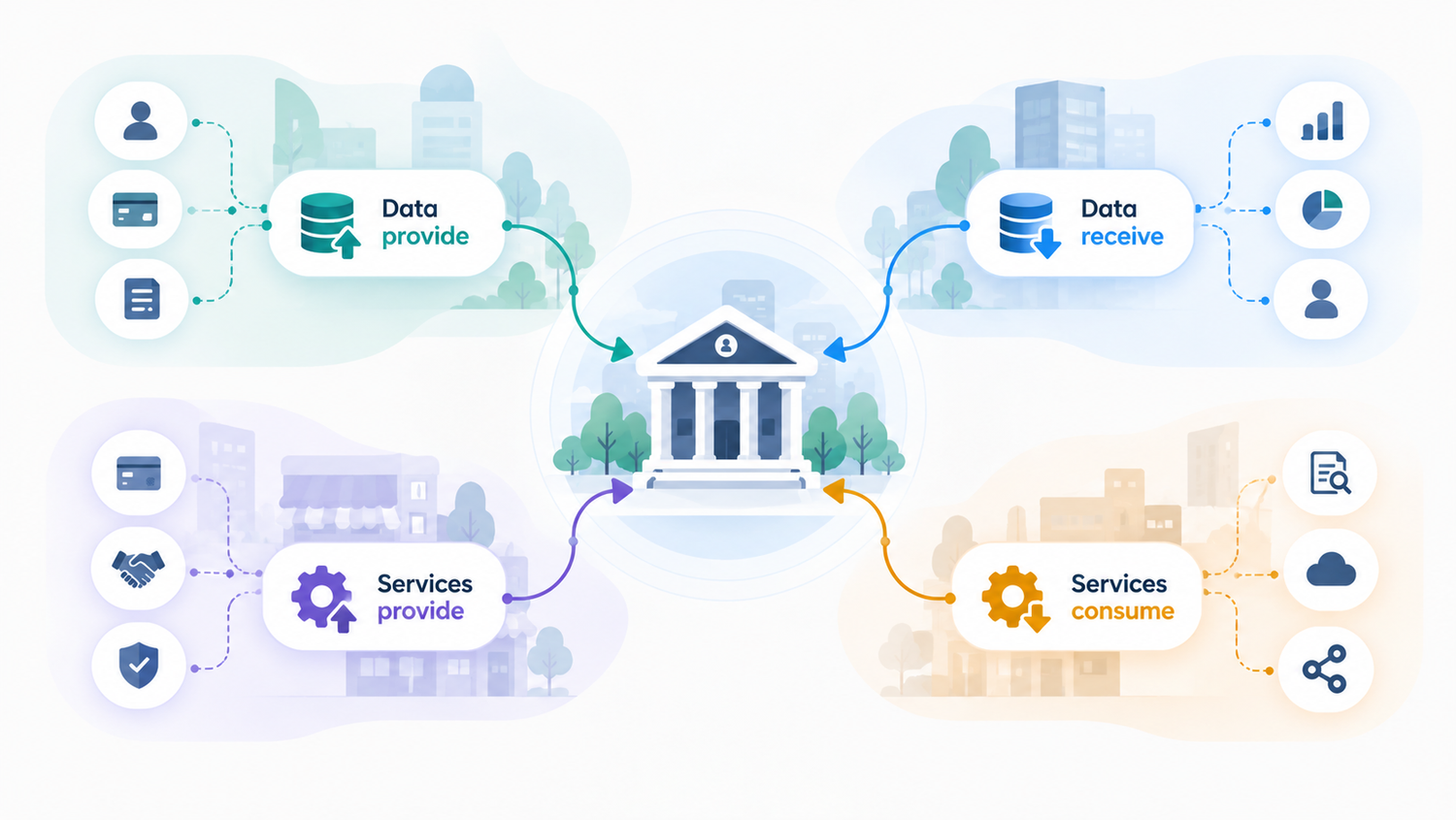
Consider a financial institution providing a lending product. To support its decisioning, it might receive customer-permissioned financial information held by other institutions participating in the ecosystem. In this interaction, the institution providing the lending product is itself a Data Recipient.
Receiving that data doesn't mean the institution has to build every capability required to interpret and use it. A specialist loan-origination fintech could also participate in the ecosystem, providing a service that helps process relevant Open Data and supports elements of the institution's lending decisioning.
The financial institution is now both a Data Recipient and a Service Recipient. The fintech is a Service Provider and, depending on how its service operates, may also be a Data Recipient. Meanwhile, the financial institution remains the provider of the lending product and customer relationship.
The same financial institution might simultaneously be providing customer-permissioned account data for a completely different service elsewhere in the ecosystem. In that interaction, it becomes the Data Provider.
This is why participant roles shouldn't necessarily be treated as permanent labels attached to particular types of organizations. A bank isn't inherently a Data Provider and a fintech isn't inherently a Data Recipient. Their roles are determined by what they are doing within a particular interaction.
That gives us four useful questions when looking at participation in an Open Data ecosystem:
-
What data does the organization provide?
-
What data does it receive?
-
What services does it provide?
-
What services does it consume?
An organization could occupy one of those positions, several of them, or move between them as different customer journeys take place.
From Bilateral Integrations to Ecosystem Participation
This distinction matters because traditional embedded finance can still depend heavily on bilateral relationships. If Financial Institution A wants to embed a capability from Fintech B, the two organizations establish a connection. If the institution then wants another capability from Fintech C, another integration may be required. As participation grows, the number of individual connections and relationships can grow with it.
An Open Data ecosystem offers a different model. Instead of approaching every use case as an isolated connection between two organizations, participants can operate within a governed environment where data and services can be made available to other authorized participants.
This doesn't mean every contractual, commercial or regulatory relationship disappears. Different services will still carry different responsibilities and requirements. But participation in a common ecosystem can reduce the need to create a bespoke technical arrangement from the ground up every time two organizations want to interact.
This is the wider shift we explored in From Pipelines to Platforms. Traditional financial services have largely operated through linear value chains: products are created within the institution and distributed outward through channels the institution controls. Platform models create value differently by enabling participants to interact, exchange and contribute value across a wider network.
For embedded finance, that changes the opportunity significantly. A financial institution isn't simply connecting its products to more external endpoints. It can become a participant in an environment where organizations both provide and consume value.
The Financial Institution Doesn't Disappear
There is sometimes an assumption that embedded finance means financial institutions retreating into the background while technology companies take ownership of the customer relationship. It doesn't have to.
Embedded finance can instead allow banks and credit unions to extend their reach beyond the channels they own. George Sr.'s credit union doesn't need to own the dealership to provide the financing. A financial institution doesn't need to own a business's accounting platform to provide a relevant financial service within it. Nor does it need to own a university's onboarding experience to participate when a student needs an account or payment capability.
What the institution needs is a way for its trusted capabilities to participate securely in those environments.
This can turn APIs and Open Data infrastructure from mechanisms associated primarily with allowing data to leave financial institutions into potential distribution infrastructure through which institutions can also deliver services and consume capabilities from elsewhere in the ecosystem.
From Embedded Finance to Agentic Finance
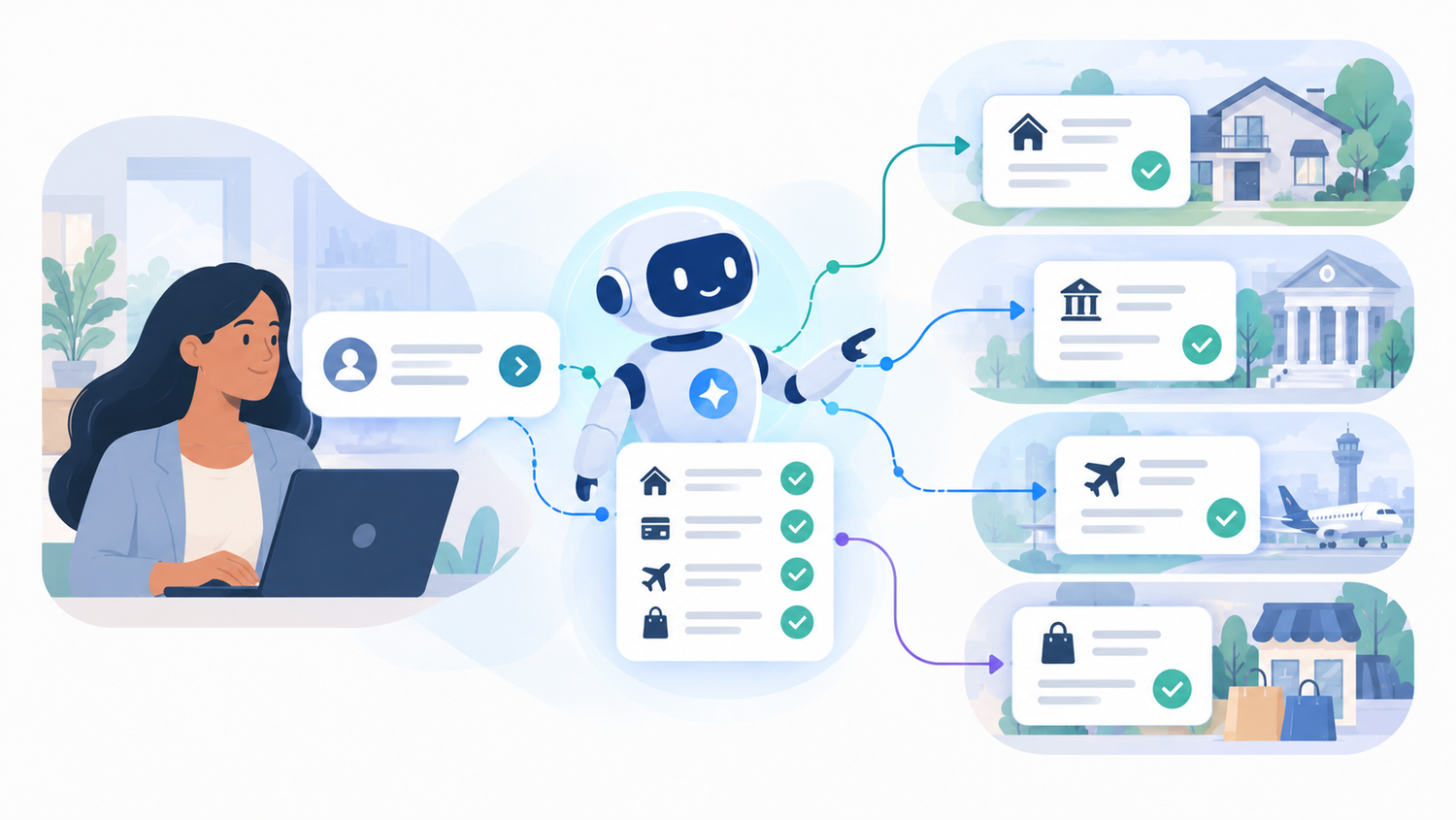
The next stage of this evolution may change the point of interaction again.
Embedded finance places financial capability into the context where a customer needs it. Agentic AI introduces the possibility that software could increasingly understand that context, identify a need and help coordinate the data and services required to address it.
An embedded lending experience, for example, might make financing available when someone reaches a particular point in a purchasing journey. An agentic experience could potentially recognize the need, gather information the customer has authorized it to access, interact with relevant services across an ecosystem and help the customer evaluate the available options.
For a business owner, an agent could potentially identify an approaching cash-flow constraint from permitted financial and business information and investigate appropriate options. A consumer might ask an agent to compare financial products using information from across their financial life rather than manually assembling that information themselves.
This follows the same behavioural evolution we described in From Cash, to Card, to Code. Digital activity is increasingly moving into conversational environments. The interaction has already progressed from asking AI to find information, to asking it to compare options. Agentic systems introduce the next instruction: “Do it for me.”
That transition also introduces important questions for Open Data infrastructure. Giving an agent permission to access information isn't necessarily the same as giving it authority to act. An agent authorized to compare lending products shouldn't automatically be assumed to have authority to apply for one. Permission to examine account information doesn't automatically confer permission to move money.
Identity, consent and authorization therefore become increasingly important as the degree of agency increases. An ecosystem needs to be able to understand who or what is acting, on whose behalf, what information it is permitted to access, what actions it has been authorized to take, for what purpose and within what boundaries.
Embedded finance moves financial services closer to customer intent. Agentic finance has the potential to go a step further by helping customers act on that intent.
Finance at the Point of Need
Financial needs don't begin inside financial institutions. They arise when somebody buys something, starts a business, hires an employee, begins university, replaces equipment or encounters an unexpected expense. For decades, customers have had to take those needs back to finance. Embedded finance allows financial services to travel in the other direction, placing them closer to the context in which the need actually occurs.
Open Data expands that opportunity. Instead of simply distributing an individual financial product into another channel, organizations can participate in connected ecosystems where they provide and receive data, provide and consume services, and combine specialist capabilities to create new customer propositions.
Agentic AI could extend that model again, enabling technology to coordinate increasingly complex interactions around customer intent. But the underlying direction remains the same.
Finance follows behaviour.
As the places where people live, work, buy, communicate and make decisions continue to change, financial services will continue to follow them.
Take financial services beyond your own channels
C1OD provides the Open Data infrastructure that enables organizations to securely provide and consume data and services across connected ecosystems — helping put the right financial capabilities closer to the point of need.