
Consent Management in Open Data
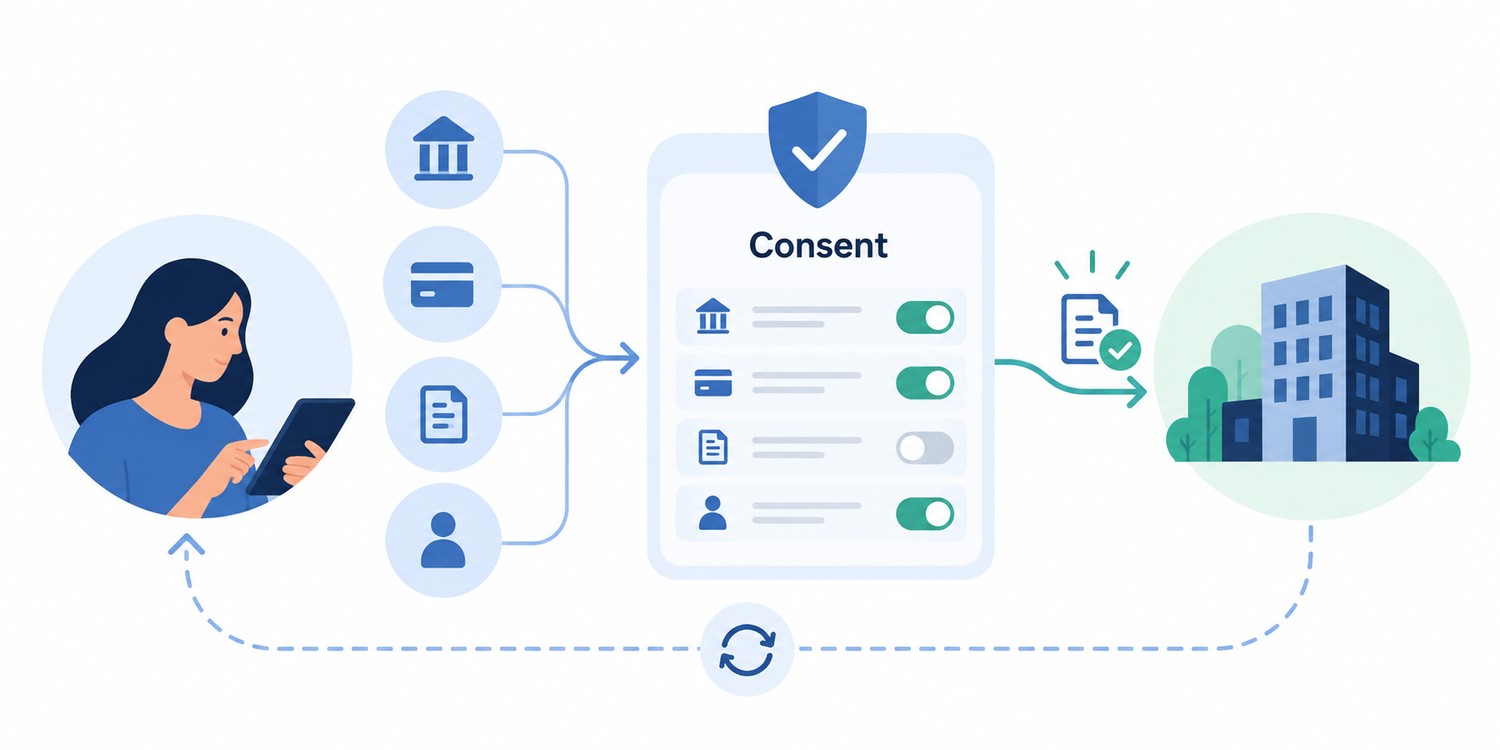
Information in this article reflects the regulatory and industry landscape as of October 2026.At the heart of Open Banking is a simple principle: consumers have the right to share their financial data with organizations they choose, for services they want to use.
But the right to share data must be accompanied by transparency and control. Fundamental data protection principles mean consumers should be able to understand what data is being shared, who has access to it, why it is being used, where it is going and for how long. They should also be able to understand and manage those choices over time.
Making data technically available is therefore only part of the challenge. For an Open Data ecosystem to work, people need to understand and control what happens to their data.
That is where consent management comes in.
Consent management is not simply asking someone to accept a set of terms before data is shared. It is the ongoing process through which an individual can understand, authorize, review and change how their data is accessed and used across an ecosystem.
As Canada develops Consumer-Driven Banking and, over time, potentially broader Open Finance and Open Data models, effective consent management will be fundamental to creating ecosystems people can trust. Common standards also have an important role to play in translating a customer's choices into permissions that can be consistently understood and enforced by the organizations participating in those ecosystems.
C1OD adopts standards developed by Financial Data Exchange (FDX) to support secure, interoperable financial data sharing. FDX's approach places the end user's permission at the centre of the data-sharing relationship, connecting consent to a defined purpose, the data being shared and the parties involved.
The Role of Common Standards
For consent to work across an ecosystem, the organizations involved need a consistent way to interpret and act on the permissions a customer has granted.
C1OD adopts standards developed by Financial Data Exchange (FDX), an industry-led standards body focused on secure, interoperable, consumer-permissioned financial data sharing. FDX provides common technical standards for exchanging financial data, alongside guidance for how consent and data-sharing experiences can be structured around customer control.
Throughout this article, we'll refer to FDX where its standards and guidance help illustrate how principles such as purpose, data minimization, duration and revocation can work in practice.
What is Consent Management?
At its simplest, consent answers the question:
Has this person agreed to this use of their data?
Effective consent management goes considerably further.
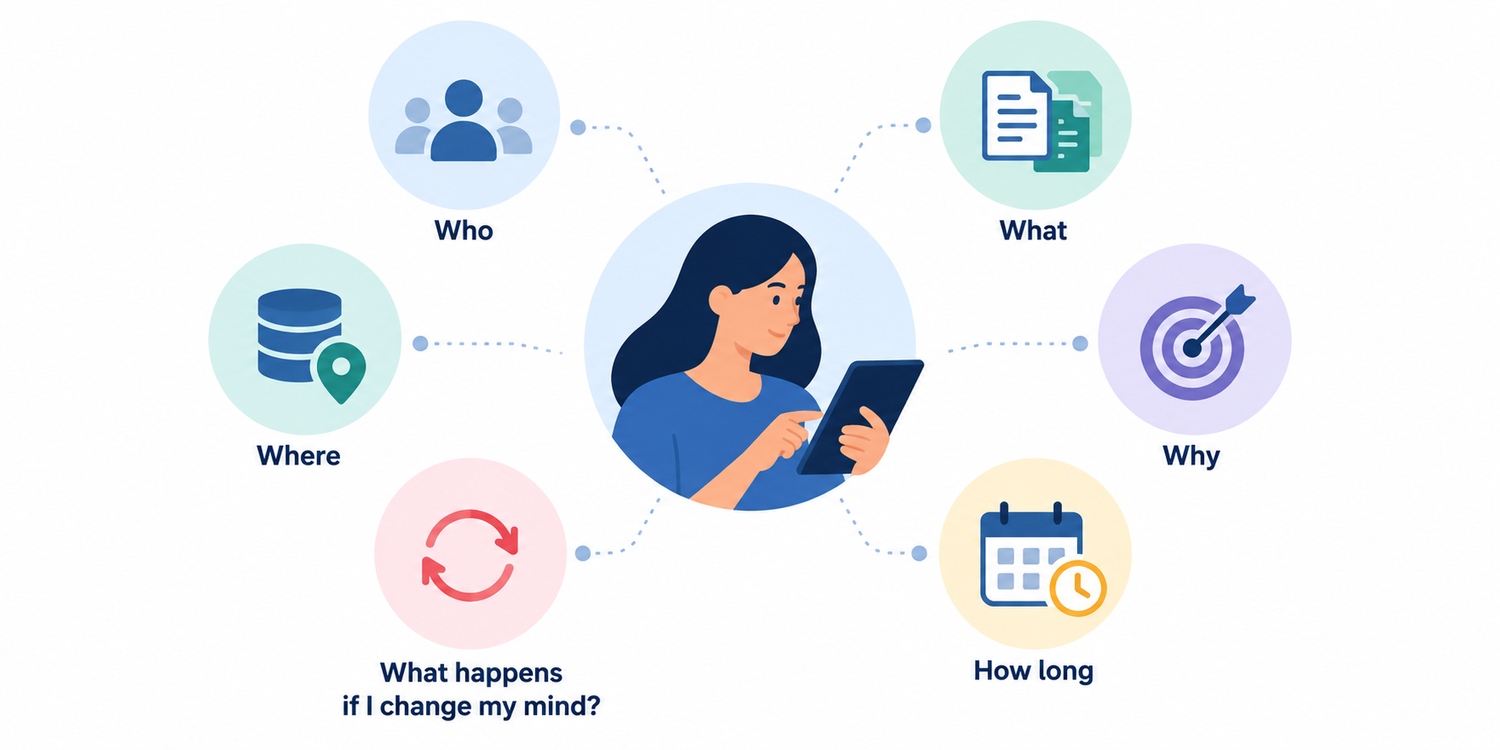
At any point, an individual should be able to understand:
-
Who has access to their data?
-
What data can they access?
-
Where is that data coming from?
-
Why is it being accessed or used?
-
How long will that permission remain active?
-
What happens if the individual changes their mind?
Consent therefore has a lifecycle. It is requested, granted, recorded and managed over time. It may be reviewed, renewed or changed and, eventually, withdrawn or expired.
Managing that lifecycle consistently becomes increasingly important as the number of organizations, datasets and services within an ecosystem grows.
Consent, Authentication and Authorization
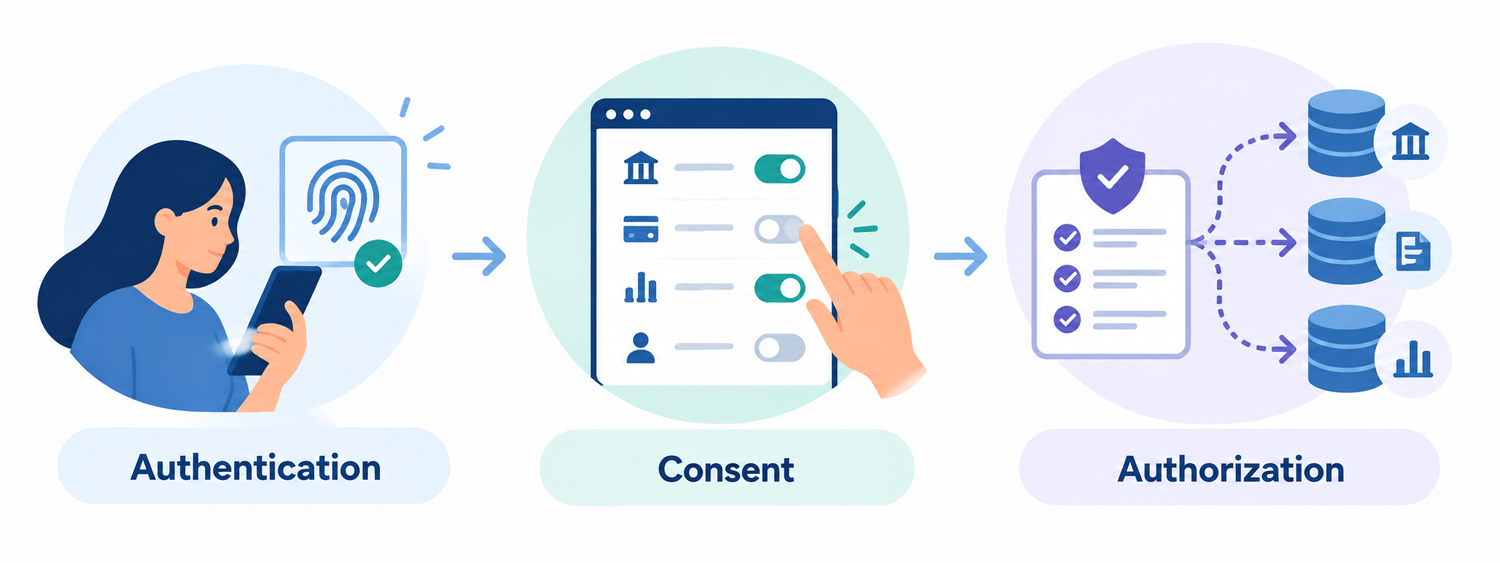
Consent, authentication and authorization are closely related, but they perform different functions within a data-sharing journey.
-
Authentication establishes who someone is, or confirms that the person attempting to initiate a data-sharing relationship is entitled to do so.
-
Consent establishes what that person has agreed may happen with their data, including what data can be shared, with whom, for what purpose and for how long.
-
Authorization translates that consent into permitted access. It determines what an authenticated party or system is actually allowed to access or do based on the permissions that have been granted.
Successfully authenticating a customer does not, by itself, mean they have consented to their data being shared. Likewise, authorization should not extend beyond the scope of the consent that has been granted.
These distinctions become particularly important in Open Data ecosystems, where multiple organizations and systems may be involved in a single customer journey.
Keeping identity, consent and permitted access distinct helps ensure that data sharing remains secure, transparent and aligned with the customer's choices.
Meaningful Consent Requires Context
A customer cannot make an informed choice simply because an interface contains an “I agree” button.
Canada's Office of the Privacy Commissioner identifies several elements that should be brought to an individual's attention when seeking meaningful consent. These include what personal information is being collected, which parties it will be shared with, the purposes for which it will be collected, used or disclosed, and any meaningful risks or consequences. Privacy information should also be presented in manageable and accessible ways.
This becomes particularly important in an Open Data environment. Consider a customer who wants an application to help them understand their finances. “Allow access to your data” tells them very little.
Try the interactive consent management tool below to see how individual data permissions can be granted, managed and withdrawn.Manage your data permissions
Choose what information can be used to support your loan application.
Account balances Confirm your current financial position Income data Help verify your income and affordability Transaction history Support a more detailed affordability assessment Other financial accounts Provide a broader view of your finances
You remain in control. Permissions can be switched on or withdrawn individually.
A more meaningful request would explain that the application wants access to specific accounts, identify the information required, explain that it will be used to analyse household spending, identify the organization receiving the data and explain how long access will continue. The objective should not simply be to obtain consent. It should be to enable the customer to make an informed decision.
This principle is also reflected in FDX consent guidance. FDX structures the consent experience around information including the parties involved, the business purpose for accessing the data, the categories of data requested, the accounts involved, the duration of access and how that access can be revoked.
Consent Should Be Proportionate to the Service
A useful principle for Open Data ecosystem design is:
Ask for the data needed to provide the service the customer has chosen, not every piece of data that might become useful later.t
A fundamental principle of responsible data sharing is data minimization: organizations should collect, access and use only the personal data necessary for a specific, clearly defined purpose.
Canada's Consumer-Driven Banking Act reflects this principle. Its consent provisions state that participating entities must not require consumers to agree to data sharing beyond what is necessary to provide the relevant product or service. The Act also requires express consent before one participating entity requests consumer data from another and requires records of that consent to be maintained.
This principle is also reflected in FDX's Data Minimization Guidelines, which recommend that data sharing be limited to information that is relevant and necessary for the specific purpose authorized by the customer. FDX guidance also connects the scope of data access to the consent granted, helping prevent broader access than the service actually requires.
This creates an important distinction between building an ecosystem and building a single, universal consent. An ecosystem may eventually support dozens of services. That does not mean a customer needs to authorize all of them on day one.
Instead, consent can develop alongside the customer's journey.
From blanket consent to progressive consent
Imagine a customer applying for a personal loan through a Canadian financial institution.
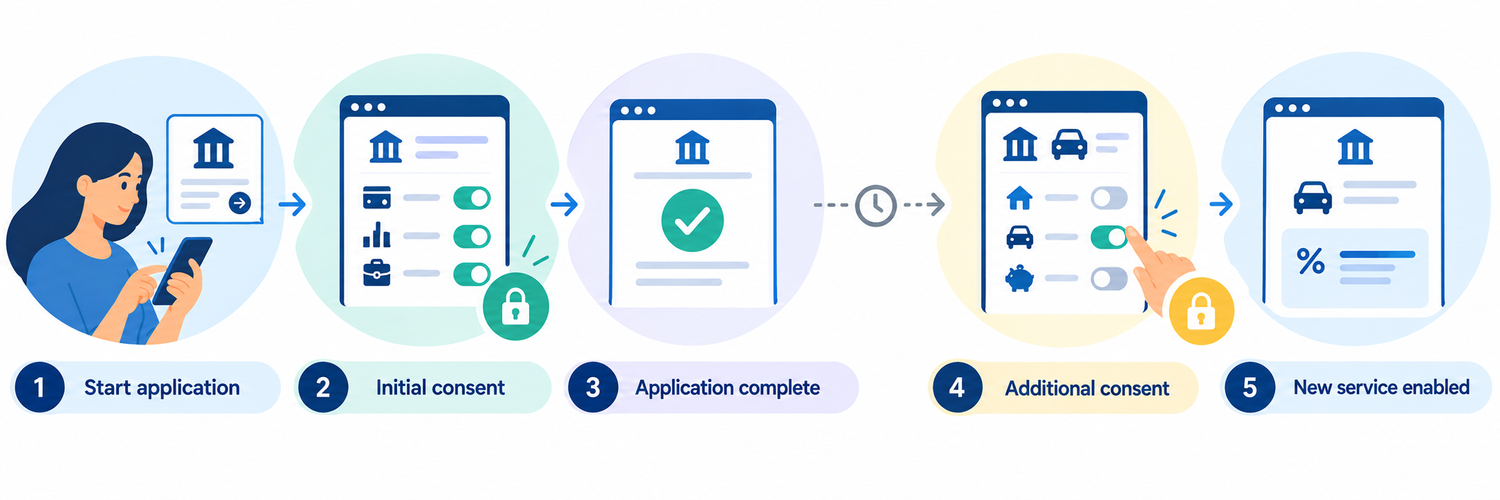
The initial proposition might be simple:
Apply for a loan
To assess the application, the customer could consent to sharing specific financial information, such as account balances, income and transaction data. This allows the lender to assess affordability and eligibility without requiring the customer to manually gather and submit information.
The customer has authorized access to specific data for a clear purpose: assessing their loan application.
Later, the customer might choose to access another service, such as:
See your personalized repayment options
Providing that service may require access to some of the same financial data or additional information. Where that access is for a different purpose or goes beyond the scope of the original consent, the customer would need to authorize the additional use.
The customer might later choose another service, such as:
Get a more complete view of your finances
This could involve connecting additional accounts or bringing data from other financial institutions into the service.
Rather than asking the customer at the beginning of the loan application to authorize access to every dataset that might support future services, additional permissions can be requested when those services become relevant.
This is progressive consent.
FDX's approach supports this separation of purpose. The same categories of financial data may be relevant to more than one service, but each distinct business purpose should be explicitly authorized rather than treating an earlier consent as permission for subsequent uses.
One of the risks in data-rich ecosystems is purpose creep. An organization obtains data for one reason and later discovers that the same information could be commercially valuable for something else. Technically having the data does not necessarily mean the organization should use it for every possible purpose.
Permission should follow purpose, not simply possession of the data.
Withdrawal needs to be as carefully designed as authorization
Giving permission should not be easy while withdrawing it is difficult.
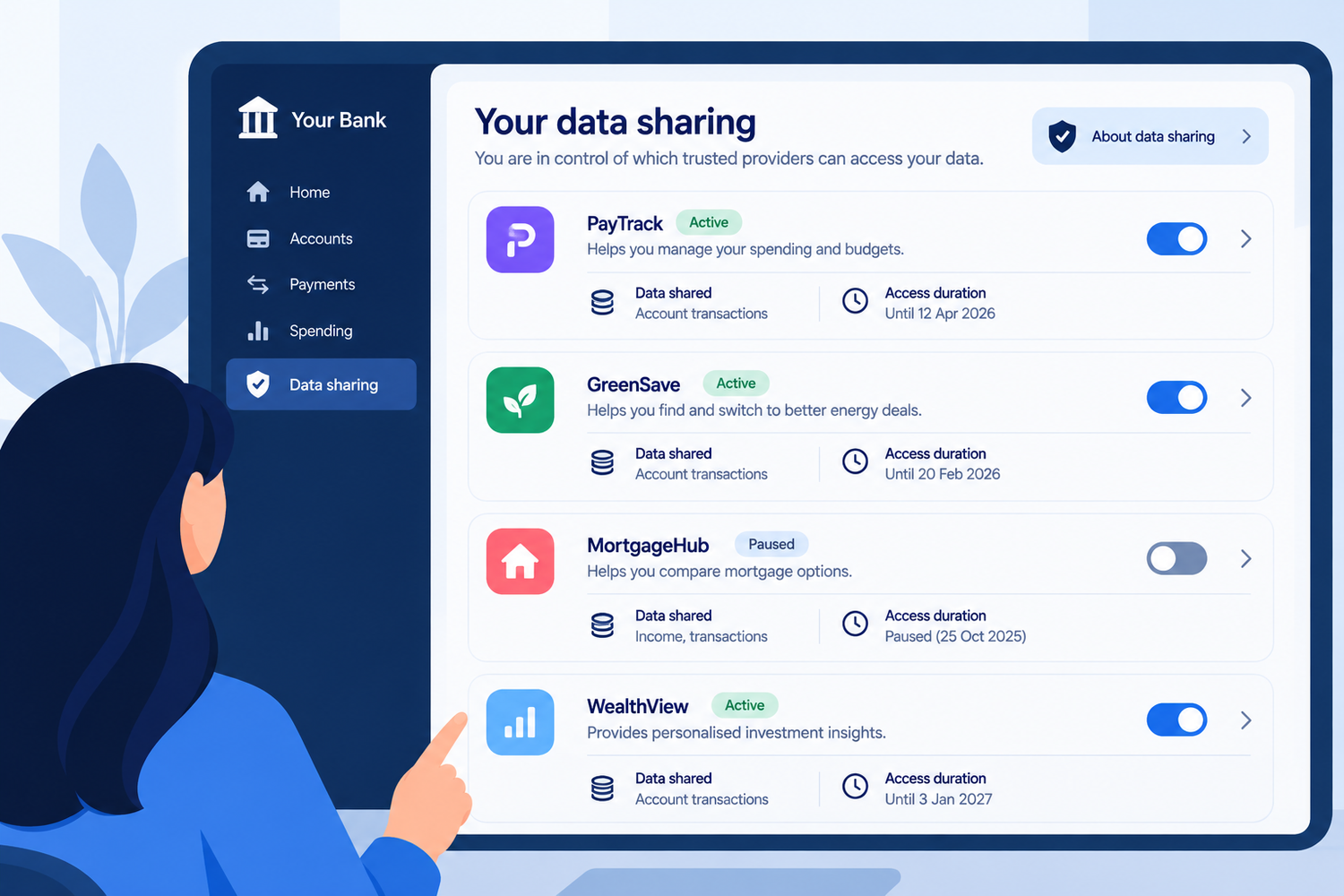
Canada's Consumer-Driven Banking Act provides for consumers to withdraw consent in whole or in part. Once withdrawal is confirmed, the receiving entity must stop receiving the affected data and notify the entity providing it. The legislation also provides mechanisms for consumers to request deletion of affected data, subject to legal requirements and regulations.
There is an important distinction here:
Stop sharing and delete my data are not necessarily the same instruction.
Stopping sharing prevents the continued flow of information. Deletion concerns information that has already been received.
There may also be circumstances where an organization has a legal requirement to retain certain records.
FDX guidance extends this principle beyond the initial consent journey into ongoing consent management. It recommends that customers are given a way to view and manage active data-sharing relationships, including information such as the organizations involved, connected accounts, categories of data being shared, the product or service the sharing supports and when the authorization expires.
FDX also considers where that control should sit across the ecosystem. Data Recipients — and Data Access Platforms acting on their behalf where applicable — should provide a mechanism for customers to revoke authorization, while FDX also provides guidance for Data Providers that choose to offer their own consent dashboards. When consent is revoked, that change needs to be communicated between the relevant parties so that data sharing stops consistently across the relationship.
Consent management therefore needs to work in both directions: making it straightforward to grant access and equally straightforward to understand, change or withdraw it later.
Consent Needs an Infrastructure Layer
The customer sees a consent screen. Behind that screen, considerably more needs to happen.
An Open Banking or Open Data ecosystem needs to maintain a reliable record of the permissions governing each data-sharing relationship. That consent relationship needs to be represented in a form that participating systems can understand and enforce.
That might include:
-
Customer — who granted the permission?
-
Data Provider — where is the information coming from?
-
Data Recipient — who is receiving it?
-
Data Access Platform — is another party facilitating the exchange?
-
Data scope — which accounts and categories of data are included?
-
Purpose — what product or service has the customer authorized the data to support?
-
Duration — how long does that authorization remain active?
-
Status and history — is the authorization active, changed, expired or withdrawn?
This is where common standards become particularly important. FDX provides common terminology and structures for representing elements of a consent relationship, including the parties involved, Business Purpose, Data Clusters, accounts and duration.
Rather than consent existing only as something the customer saw on a screen, those permissions can be reflected in the data-sharing relationship itself.
When a customer changes or withdraws their permission, that change also needs to be communicated between the relevant participants so that the new consent state can be consistently enforced.
Consent management is therefore both a customer experience problem and an infrastructure problem.
When AI Agents Act on the Customer's Behalf
As Open Data ecosystems become more connected, another question is emerging: what happens when it is no longer the customer directly requesting data or initiating an action?
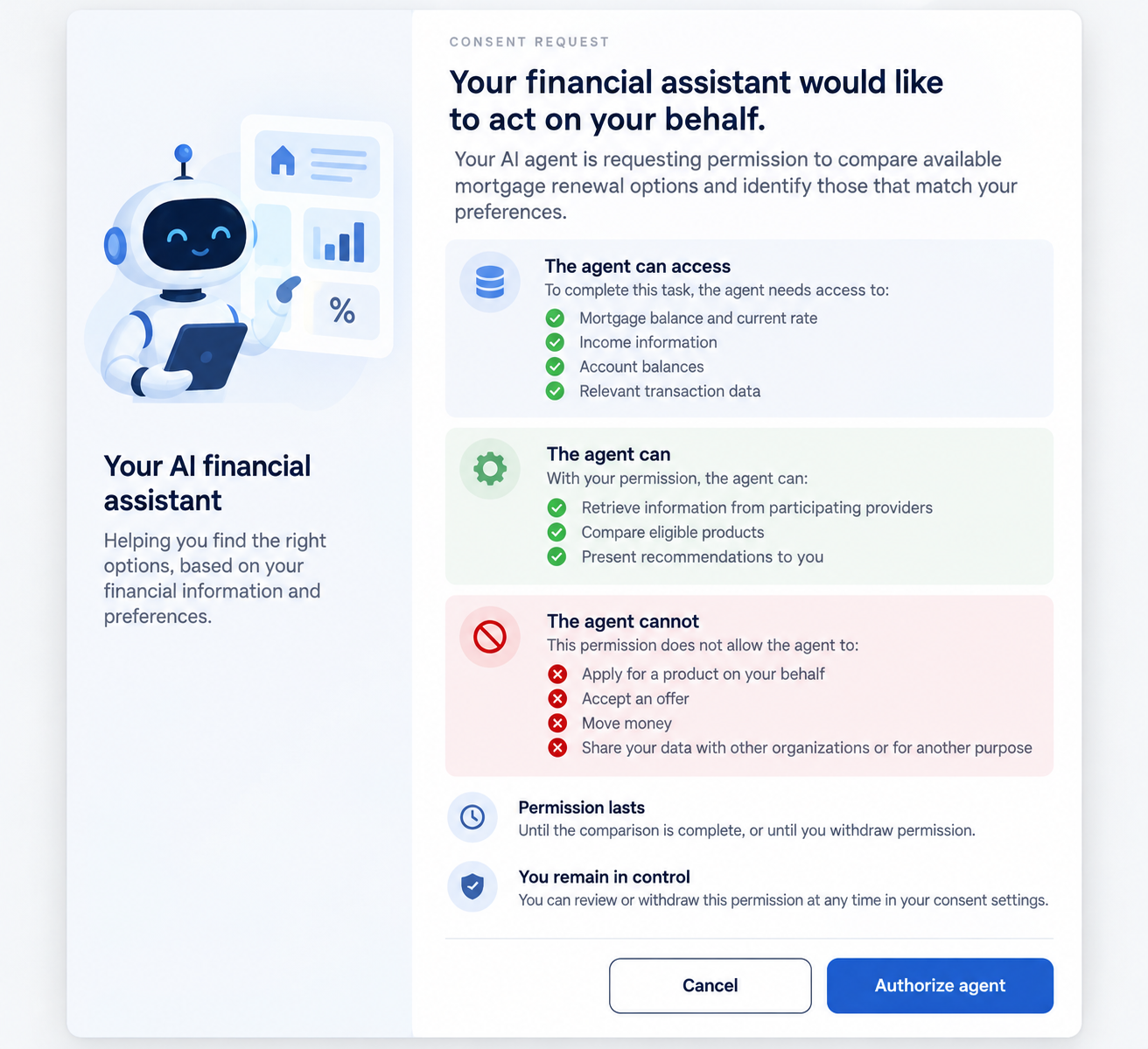
AI agents have the potential to act on a customer's behalf — finding information, comparing services, accessing data and potentially initiating actions across an ecosystem.
That makes the distinction between authentication, consent and authorization even more important.
A customer may authorize an agent to access particular information for a defined purpose. That does not necessarily mean the agent has authority to access other data, use it for another purpose or take consequential actions on the customer's behalf.
An agentic ecosystem therefore needs to be able to answer additional questions:
-
Who is the agent acting for?
-
What has the customer instructed it to do?
-
What data has the customer consented to share?
-
What actions has the agent been authorized to take?
-
How long does that authority last?
-
And how can it be withdrawn?
The same principles that underpin effective consent management — purpose, data minimization, granularity, duration, transparency, traceability and revocation — become even more important when software is acting between the customer and the organizations holding or receiving their data.
FDX's existing approach to permissioned data sharing provides useful foundations by structuring relationships around identifiable participants, defined business purposes, specified data and accounts, duration and revocation. As agentic models develop, the challenge extends beyond determining who is requesting access to establishing under whose authority an agent is acting and what that authority allows it to do.
From Permission to Participation
The long-term opportunity in Open Data is not simply to create more routes through which organizations can access information. It is to enable people to participate confidently in ecosystems where their data can create new services and experiences.
That requires consent to be treated as more than a screen standing between the customer and a product. It needs to operate across the lifecycle of the relationship: understandable to the customer, enforceable by the infrastructure and adaptable as their choices change.
As Canada develops Consumer-Driven Banking and looks towards broader Open Finance and Open Data opportunities, interoperable standards such as FDX can provide part of the foundation for making those choices work consistently across an ecosystem.
And as those ecosystems evolve to include AI agents acting on customers' behalf, the underlying principle becomes even more important:
Access and action should remain connected to the authority the customer has actually granted.
Consent Management Beyond Banking
Consumer-Driven Banking provides a relatively bounded example of data sharing. As data sharing expands into broader Open Finance and Open Data ecosystems, consent becomes more complex.
A single customer journey could involve data from multiple sectors and organizations. Financial information might sit alongside data from areas such as insurance, utilities, telecommunications, government services or other data-rich industries.
Each source may involve different data providers, recipients, infrastructure providers, legal frameworks, refresh cycles and permitted uses. Yet from the customer's perspective, these should not feel like a collection of disconnected data-sharing relationships.
As ecosystems expand, specialist infrastructure providers can help participating organizations manage functions such as consent orchestration, authentication and secure data movement consistently. But outsourcing technology does not mean outsourcing accountability.
The customer should not need to understand the technical complexity behind the ecosystem. Their experience should remain straightforward:
-
Here is what you are connecting.
-
Here is why.
-
Here is what you will receive in return.
-
Here is who will have access.
-
Here is how long that access lasts.
-
And here is where you can change your mind.
The complexity belongs in the infrastructure, not in the customer journey.