
What is Open Data?
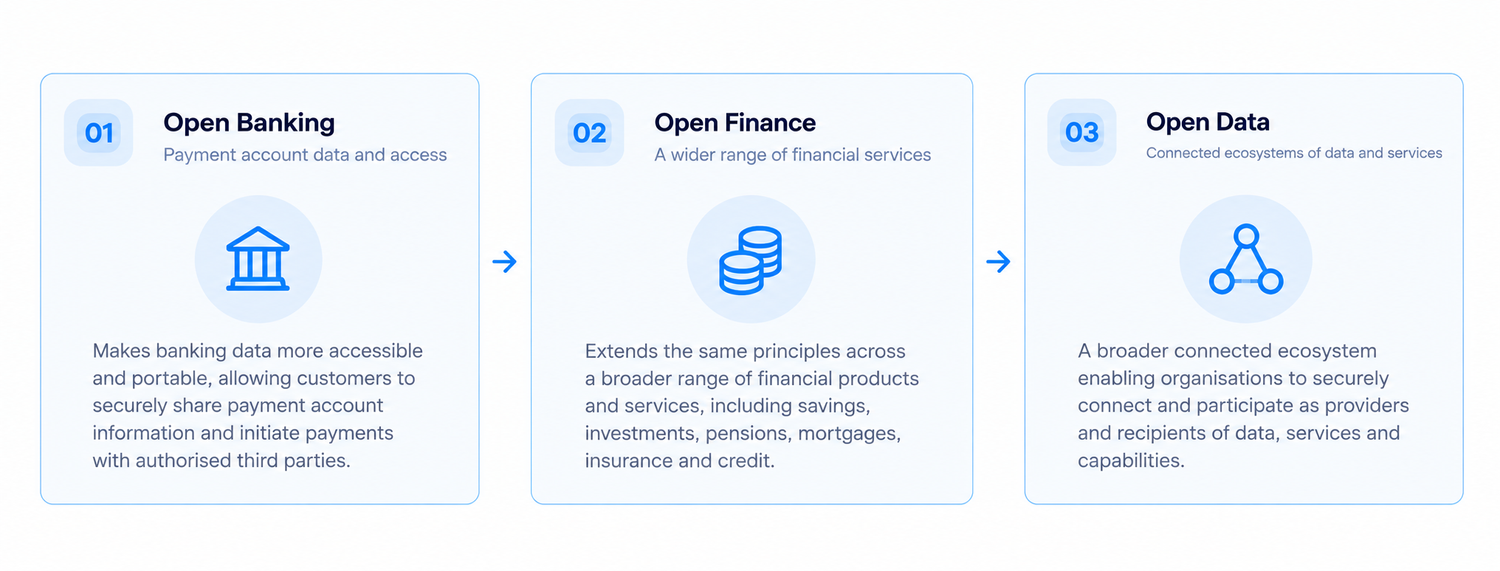
Open Data is the next stage in the evolution of how financial institutions, technology providers and other organizations connect and exchange data and services.
To understand what Open Data means, it helps to start with Open Banking.
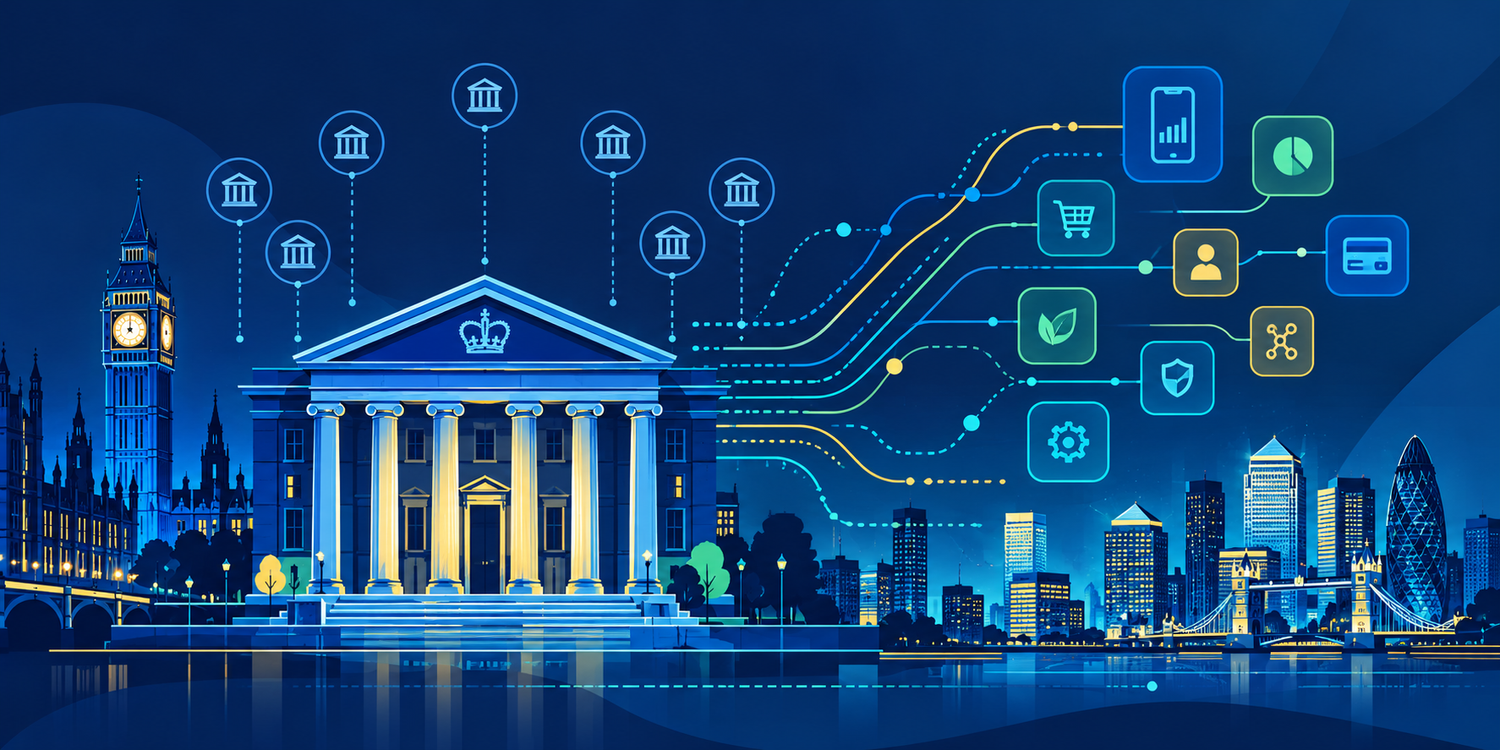
It started with Open Banking
Open Banking was developed to make banking data more accessible and portable, allowing customers to securely share information held by their bank with authorized third parties.
The UK was one of the earliest markets to implement Open Banking at scale. Following an investigation into competition in retail banking, the Competition and Markets Authority (CMA) required the UK's nine largest banks and building societies, known as the CMA9, to implement common Open Banking standards. One of the objectives was to increase competition and innovation by making it easier for new providers to develop services using customers' banking data.
Rather than financial information remaining locked within an individual bank, customers could give permission for regulated third parties to access payment-account information through standardized APIs.
Initially, this largely centred on information such as account details, balances and transaction history, alongside the ability to initiate payments. This enabled services including account aggregation, budgeting tools, financial management applications and alternative payment experiences.
It was an important shift. The customer gained greater ability to take their banking data with them and allow other organizations to use it.
From Open Banking to Open Finance
Open Finance extends the same fundamental principle beyond banking.
Instead of permissioned access being largely limited to payment-account information, Open Finance can encompass a much broader picture of an individual's or business's financial life.
That can include savings, investments, pensions, mortgages, insurance and credit.
The distinction is relatively simple:
-
Open Banking opened access to banking data.
-
Open Finance extends that access across financial services.
This creates the potential for much richer financial experiences. A service might, for example, draw upon information held across a customer's bank accounts, mortgage, pension and investments rather than seeing only one part of their financial position.
But there is another step beyond expanding the number of datasets that can be shared.
From Open Finance to Open Data
At C1OD, when we talk about Open Data, we are talking about a broader connected ecosystem.
The opportunity is not simply to make more categories of data available.
It is to create trusted infrastructure through which organizations can securely connect and participate in different ways.
A financial institution might be:
-
a data provider, making authorized data available to another participant;
-
a data recipient, consuming data from elsewhere in the ecosystem;
-
a service provider, making a capability or service available to other organizations; or
-
a service recipient, integrating external capabilities into its own operations or customer proposition.
An organization does not have to occupy only one of these roles. It can participate differently depending on the relationship, service or use case.
This changes the conversation from:
"What data do we have to make available?"
to:
"What can we provide, what can we consume, who can we connect with and what value can we create?"
That is a much broader proposition.
Importantly, participation is not limited to financial institutions. Open Data ecosystems can also enable fintechs, technology providers and other organizations to connect their services and capabilities with participating institutions. This creates a broader network in which organizations can collaborate, combine capabilities and develop new services without every participant needing to build every component themselves.
Want to understand where your organization fits?
Explore Who we help to see how different organizations can participate in the Open Data ecosystem.
Open Data is an ecosystem, not simply data sharing
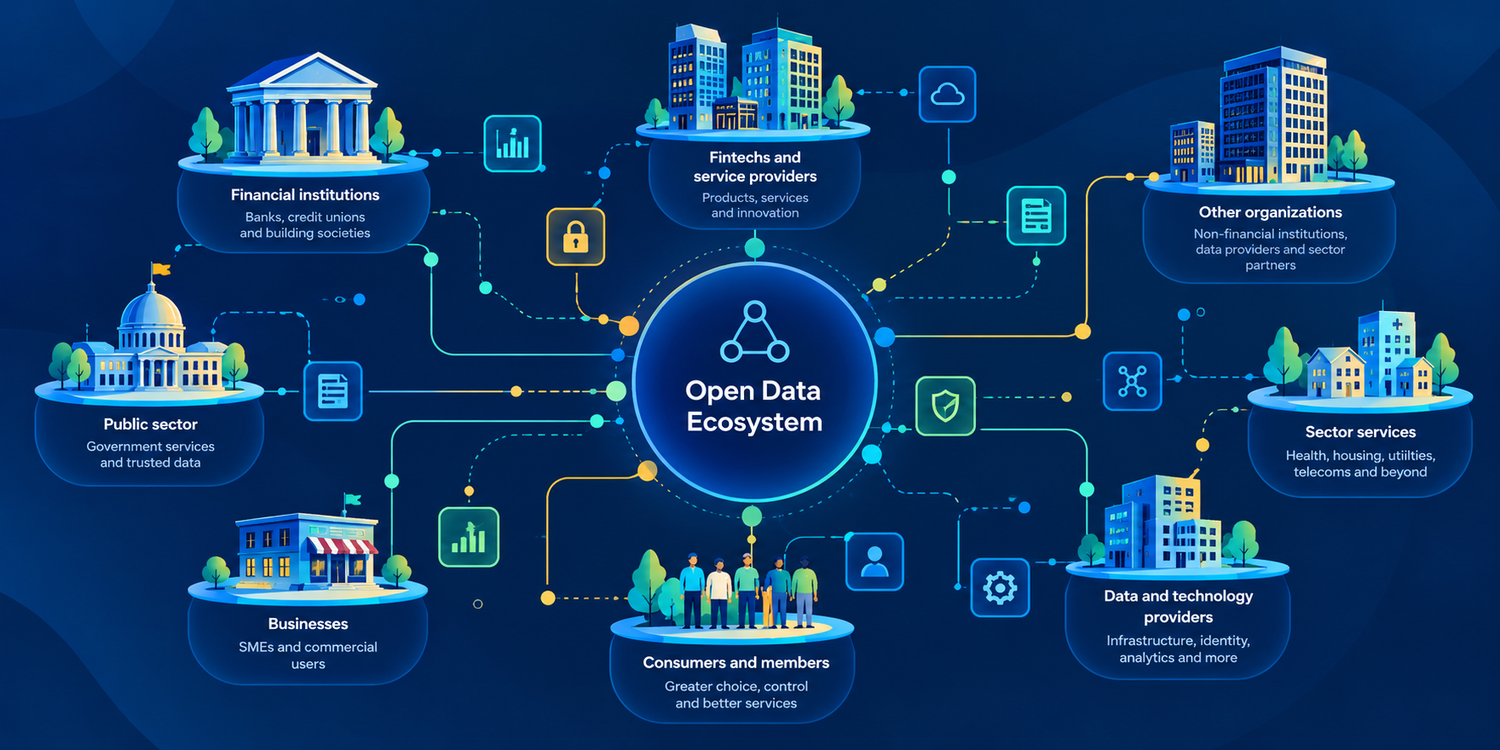
The value of Open Data does not come simply from moving information between organizations.
It comes from what becomes possible when trusted participants can connect.
A connected ecosystem can allow financial institutions to combine their own capabilities with data and services from elsewhere. Rather than building every capability internally, an institution can connect to specialist providers, incorporate new services into its customer proposition or make its own capabilities available to others.
That can support new customer experiences and revenue opportunities, but it can also create significant operational value.
Data and services that previously moved through fragmented processes or bespoke integrations can potentially become accessible through common infrastructure and standards. Institutions can reduce duplication, automate processes, improve decision-making and connect capabilities across organizational boundaries.
So Open Data is as much about how financial services operate as it is about the portability of customer data.
Why does interoperability matter?
For this model to work at scale, organizations cannot simply build a new bespoke connection every time they want to work with another participant.
Open ecosystems depend on interoperability: common approaches that allow different organizations, technologies and services to work together.
That requires more than APIs.
It requires trusted approaches to identity, authentication, consent, security, governance and technical standards so participants can establish who they are connecting with, what they are permitted to access and what they are permitted to do.
The infrastructure therefore becomes an important part of the ecosystem itself.
And now AI changes the opportunity again
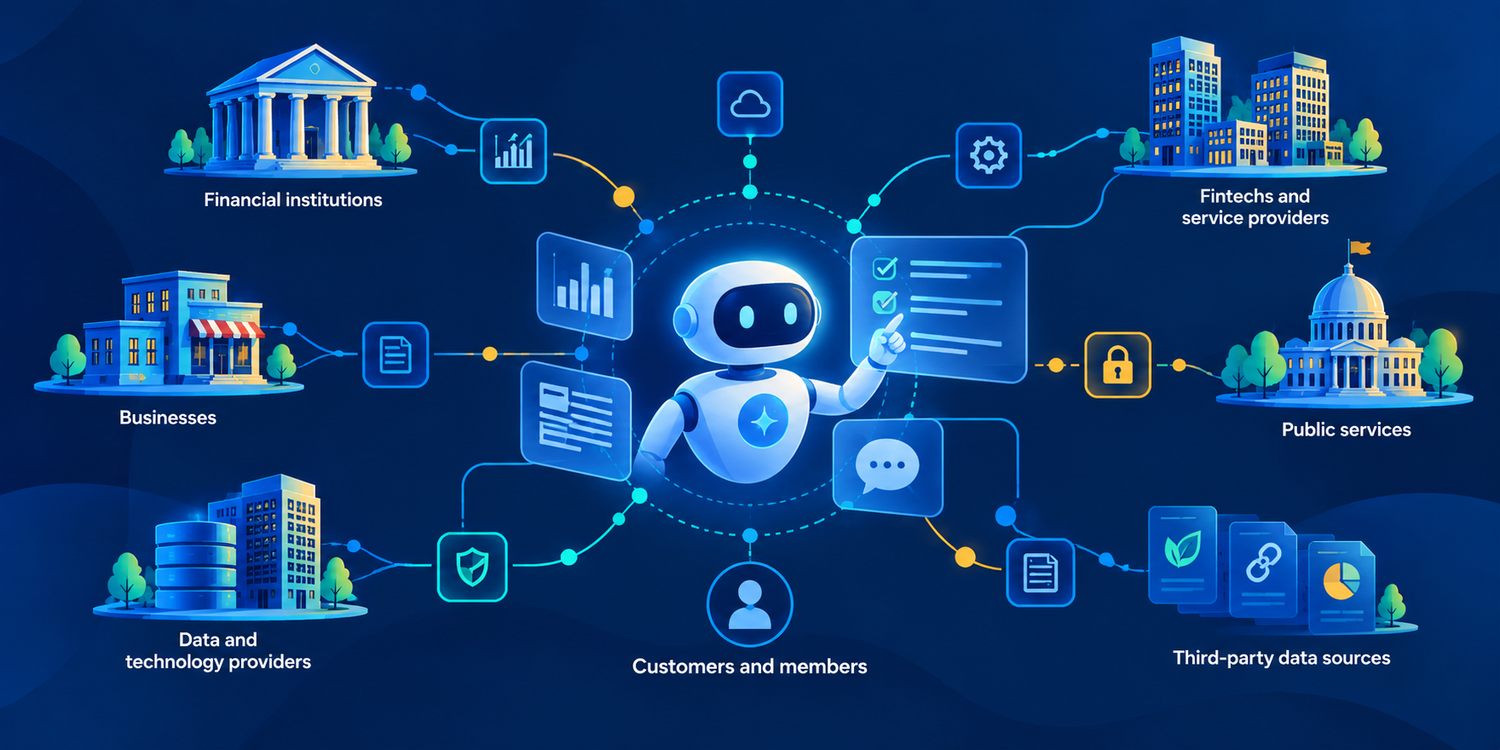
The emergence of AI and agentic technologies makes this evolution particularly significant.
AI can already help interpret large amounts of financial information. Agentic technologies introduce the possibility of systems that can go further, acting on behalf of a customer or organization within defined permissions.
The infrastructure implications are substantial. In September 2026, FCA-commissioned research into Open Finance infrastructure specifically highlighted that increasingly capable AI-enabled services create new requirements around verification, delegation and accountability.
An AI agent that can identify that a customer could save money is useful.
An authorized agent operating within a trusted ecosystem could potentially identify an opportunity, connect with the appropriate service and take a permitted action.
That requires secure access to data, but it also requires identity, permissions, governance, interoperability and connectivity between services.
These are many of the same foundations being established for Open Data today.
From portability to participation
The evolution from Open Banking to Open Finance and Open Data can therefore be understood as an expansion in both scope and participation.
Open Banking began by making payment-account data portable and enabling authorized third parties to use it, helping stimulate competition and innovation.
Open Finance extends those principles across a much broader range of financial products and data.
Open Data, as we approach it at C1OD, goes further by considering how organizations can actively participate in connected ecosystems, providing and consuming data, services and capabilities.
The ultimate opportunity is not simply to open more data.
It is to create the trusted infrastructure that allows financial institutions and other participants to connect, participate and create value.
Talk to us at C1OD to discuss how our open data ecosystem can help your organization.